
Terminology#
Background Documents on Risk Assessment in Engineering
Document #7
JCSS — Joint Committee of Structural Safety
Date: November 2008
JCSS author: Milan Holický, Klokner Institute, Czech Technical University, Prague
INTRODUCTION#
The following definitions are provided to assure consistent understanding of selected terms within the scope of WP 2 of JCSS. The aim of WP 2 is to improve general knowledge and understanding within the fields of safety, risk, reliability and quality assurance for all types of civil engineering works and activities. The following documents have been used for the preparation of this draft; the definitions provided in recent CIB TG 32 document [8] ISO/IEC Guide 73 [9] are acknowledged in particular.
[1] NS 5814 Requirements for risk analysis. 1991.
[2] CAN/CSA - Q634-91 Risk analysis requirements and guidelines.1991.
[3] ISO 2394 General principles on reliability of structures. 1998.
[4] ISO/DIS 8930 General principles on reliability of structures - List of equivalent terms. 1999.
[5] TNO report 96-CON-R1599 Proposal for a framework in behalf of developing terminology with regard to the process of the probabilistic design and/or assessment of building and civil engineering structures with reference to ISO 8930. 1996.
[6] M.G. Stewart and R.E. Melchers, Probabilistic risk assessment of engineering system. Chapman & Hall, London 1997.
[7] EN 1990: Basis of design. CEN TC 250, Draft, November 1999.
[8] CIB TG 32, Report 259 Risk assessment and risk communication in civil engineering, CIB secretariat 2001.
[9] ISO/IEC Guide 73: 2002, Risk management – Vocabulary - Guidelines for use in standards.
[10] ISO 9000: 2000, Quality management systems – Fundamentals and vocabulary.
[11] ISO/IEC Guide 51: 1999, Safety aspects – Guidelines for their inclusion in standards.
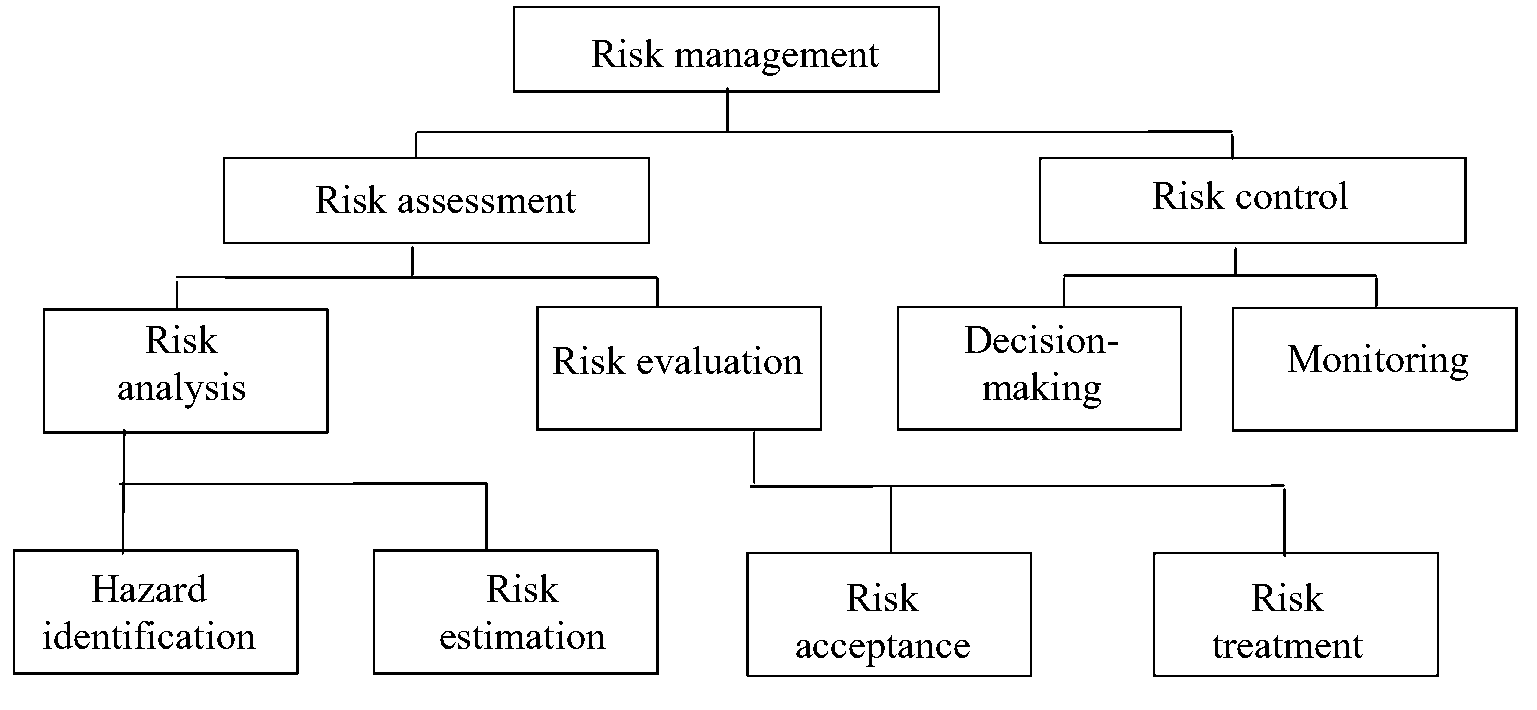
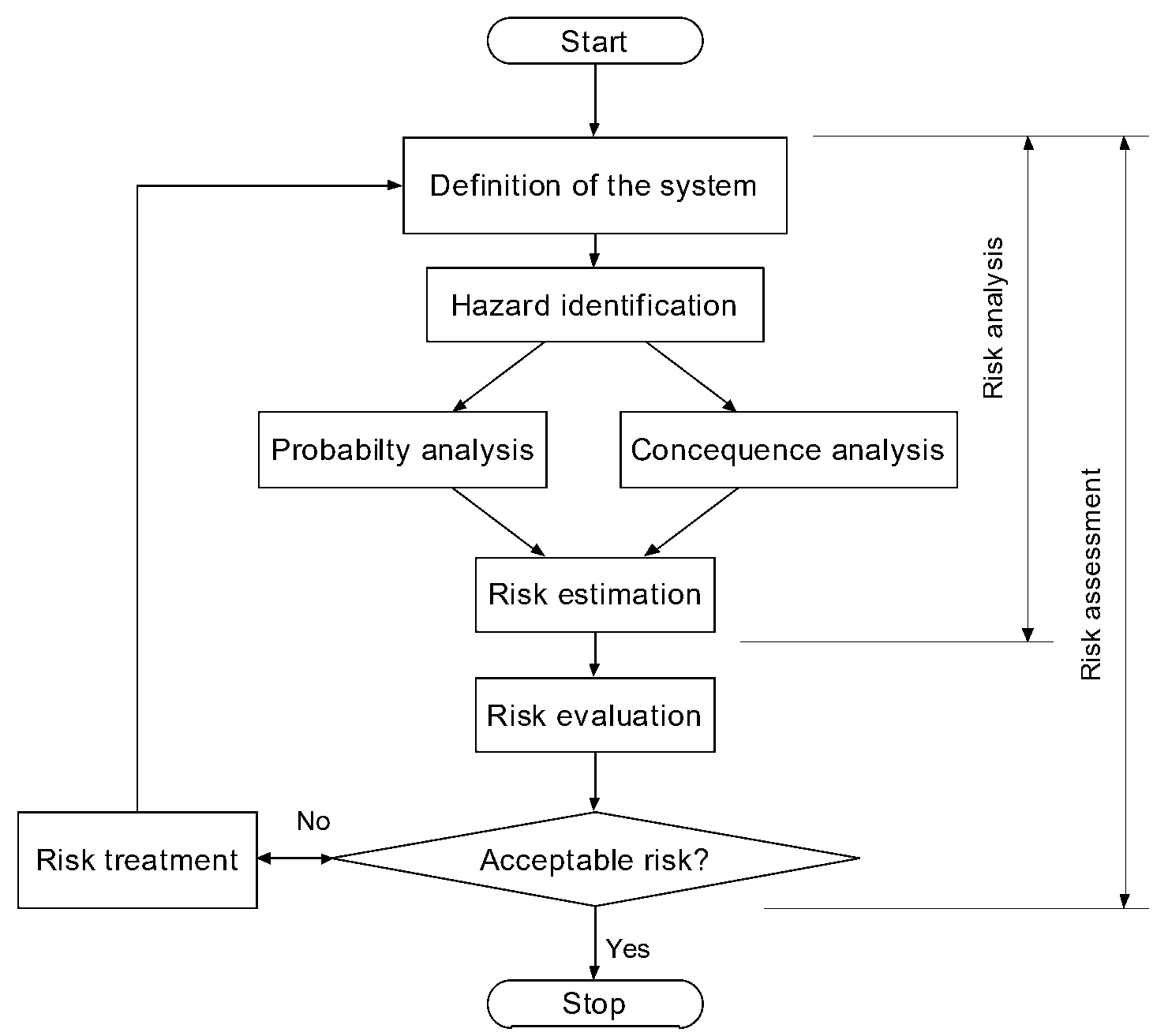
Considering the main area of their application the terms are subdivided into the following four groups: general terms, terms related to risk communication, terms related to risk assessment and terms related to risk control. General terms and terms related to risk communication concern all activities of risk management indicated in Figure 1. Terms related to risk assessment and risk control are primarily applicable in the corresponding areas of risk assessment and risk control (see Figure 1 and Figure 2).
1 GENERAL TERMS#
1.1 Hazard: An event or a combination of events with a potential for undesirable consequences.
Note 1: For instance an occurrence of abnormal action or environmental influence and/or insufficient strength or resistance or excessive deviation from intended dimensions.
Note 2: In the recent draft of EN 1990 [7]) the hazard is defined similarly as an event. In other documents concerning risk analysis [2] it is considered as a condition with a potential for causing event, thus, as a synonym to danger..
1.2 Hazard scenario: A sequence of possible events caused by a given hazard and leading to undesired consequences.
Note: To identify what might go wrong with the system or its subsystem is crucial to a risk analysis. It requires the system to be examined and understood in considerable detail [6].
1.3 Event: Occurrence of a particular set of circumstances.
Note: Undesired event is an event, which can cause adverse consequences like human fatalities and injuries or environmental damage and economic losses.
1.4 Probability: The likelihood or degree of belief of a particular event occurring within a specified reference (time, number of repetitions, etc.).
Note: The probability may significantly depend on the time period during which the particular event may occur.
1.5 Objective probability: The probability determined using theoretical arguments or adequate statistical data.
1.6 Subjective probability: The probability determined using intuition and relevant experience.
1.7 Consequence: The utility assigned to the event in accordance with the preferences of the decision maker.
Note 1: There can be more than one consequence from one event.
Note 2: Consequences can range from beneficial to adverse.
Note 3: Consequences can be expressed qualitatively or quantitatively.
1.8 Risk: The expected adverse consequences associated with an event, an activity or a decision alternative. Risks may be related to adverse events for humans, qualities of the environment or economic values. In general the risk is the combination of probability of an event and its consequence [9].
Note 1: The risk is often estimated by the mathematical expectation of the consequences of an undesired event. Then it is the product “probability × consequences”. However, a more general interpretation of the risk may involve probability and consequences in a non-product form. This presentation is sometimes useful, particularly when a spectrum of consequences, with each having its own probability of occurrence, is considered [2].
Note 2: Various levels of risk may be recognised, for example objective risk, acceptable risk or tolerable risk and [6] (see the definition of these terms, 1.9, 2.6 and 4.4).
1.9 Objective risk: An estimate of the system risk, obtained using theoretical arguments or adequate statistical data (for example the annual expected fatalities from car accidents) or from quantified risk analysis methods (QRA, PRA).
1.10 Reliability: The ability of a structure or structural element to fulfil the specified requirements during a given period of time (e.g. design life).
Note 1: The reliability is often expressed as a probability related to a specific requirement and a period of time [3,4,5].
Note 2: With respect to ultimate limit states, the reliability is often referred to as safety, with respect to serviceability limit states, the reliability is often referred to as serviceability [3,4,5].
1.11 Risk management: The complete process of risk assessment and risk control.
Note: The entire risk management is schematically indicated in Figure 1 (adapted from [2]).
1.12 Safety: The state of being protected against hurt or injury, freedom from danger or hazard.
Note: In structural reliability the safety is often understood as the reliability with respect to ultimate limit state (see the definition of Reliability).
1.13 System: A bounded group of interrelated, interdependent or interacting elements forming an entity that achieves a defined objective in its environment through interaction of its parts.
Note 1: This definition implies that the system is identifiable, is made up of interacting elements or subsystems, all elements are identifiable, and the boundary of the system can be identified [2].
Note 2: In terms of technological hazards, a system is normally formed from a physical subsystem, a human subsystem, their management, and environment [2].
4 TERMS RELATED TO RISK CONTROL#
4.1 Risk treatment: A process of selection and implementation of measures to modify risk [9].
Note 1: The term “risk treatment” is sometimes used for the measures themselves.
Note 2: Risk treatment measures can include avoiding, optimizing, transferring or retaining risk.
4.2 Safety management: A systematic process undertaken by an organisation in order to attain and maintain a level of safety that complies with the defined objectives.
4.3 Tolerable risk: A level of risk, which an individual or society is willing to accept to secure certain benefits assuming that the risk will be properly controlled.
Note: The tolerable risk may not be negligible but it should be kept under review and permanent control [6].
4.4 Risk control: Actions implementing risk management decisions.
Note: Risk control may involve monitoring, reevaluation, and compliance with decisions.
4.5 Risk optimization: A process, related to a risk, to minimize the negative and to maximize the positive consequences and their respective probabilities [9].
Note 1: In the context of safety, risk optimization is focused on reducing the risk.
Note 2: Risk optimization depends upon risk criteria, including costs and legal requirements.
Note 3: Risk associated with risk control can be considered.
4.6 Risk reduction: Actions taken to lessen the probability, negative consequences, or both, associated with a risk [9].
4.7 Mitigation: Limitation of any negative consequence of a particular event [9].
4.8 Risk avoidance: Decision not to become involved in, or action to withdraw from, a risk situation.
Note: The decision may be taken based on the result of risk evaluation.
4.9 Risk transfer: Sharing with another party the burden of loss or benefit of gain, for a risk [9].
Note 1: Legal or statutory requirements can limit, prohibit or mandate the transfer of certain risk.
Note 2: Risk transfer can be carried out through insurance or other agreements.
Note 3: Risk transfer can create new risks or modify existing risk.
Note 4: Relocation of the source is not risk transfer.
4.10 Risk financing: Provision of funds to meet the cost of implementing risk treatment and related costs [9].
Note: In some industries, risk financing refers to funding the financial consequences related to the risk only.
4.11 Risk retention: Acceptance of the burden of loss, or benefit gain, from a particular risk [9].
Note 1: Risk retention includes the acceptance of risks that have not been identified.
Note 2: Risk retention does not include treatments involving insurance, or transfer by other means.
Note 3: There can be variability in the degree of acceptance and dependence on risk criteria.
4.12 Risk acceptance: Decision to accept a risk.
Note 1: The verb “to accept” is chosen to convey the idea that acceptance has its basic dictionary meaning.
Note 2: Risk acceptance depends on risk criteria.
4.13 Residual risk: Risk remaining after risk treatment [9].
Note: See also ISO/IEC Guide 51 [11] for safety-aspects.
Source and citation#
Suggested citation: Holický, M. (2008). Terminology. Background Documents on Risk Assessment in Engineering, document #7. Joint Committee on Structural Safety, November 2008.