
B. Kohl: Risk-based decision-making in tunnel safety#
IABSE workshop on risk acceptance
Session 2 – Practical Implementation
Extended Abstract:#
In the past in Europe a tunnel was regarded as sufficiently safe if its design/current status was in line with prescriptive guidelines. Residual risks were neither addressed nor evaluated. The EC-Directive 54/2004 (1), issued as a consequence of the major tunnel fires in 1999-2001, defined unified minimum safety requirements for tunnels on the Trans-European Road Network and at the same time established risk assessment as an obligatory new tool for tunnel safety management.
Since then in Europe several different risk assessment methodologies have been established and are used on a regular basis in different national regulatory environments. These methods analyse the (collective) risk of tunnel users; they are either system-based (i.e. they address the overall risk of a tunnel) or scenario-based (i.e they investigate a few preselected and predefined scenarios). Typical risk parameters are either the Expected Risk Value (EV) or a Frequency/Consequence Curve (F/N curve) or both.
Some of these methods are also applied at international level. The World Road Association PIARC reflected the application of risk assessment in road tunnels in several reports, one of them is explicitly dedicated to risk evaluation (2).
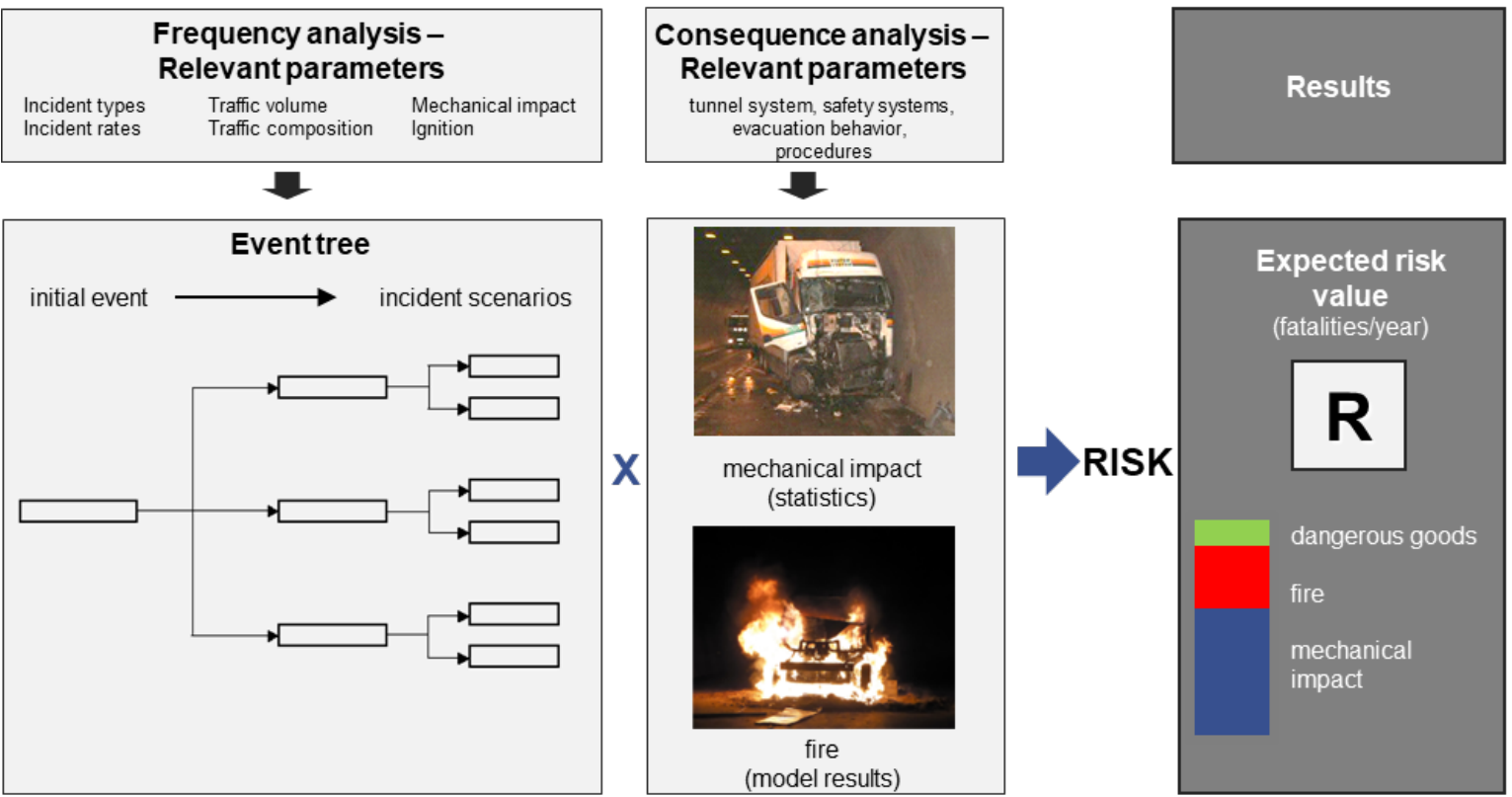
Meanwhile - based on experience in many practical applications - some of these tools have been developed further, by optimizing approaches, updating input data and adapting application rules, including strategies for risk evaluation.
Depending on the problem and the regulatory environment tunnel risk assessment tools are in use for mainly two different purposes,:
- To demonstrate a sufficient safety level
- To decide on and select (additional) risk mitigation measures
Typical use cases are tunnels with specific characteristics or deviations from prescriptive requirements, the upgrading of old tunnels, specific operational conditions with a reduced level of safety (e.g. construction phases) or decisions on operational strategies – for normal operation (e.g. limitation of transport of dangerous goods) as well as for emergencies.
This complexity involves that there are no unified risk acceptance criteria for road tunnels, they in fact depend on the method, the use case and the regulatory environment. In practice in the majority of cases relative risk evaluation approaches rather than absolute risk acceptance criteria are used, except from countries or use cases, where absolute quantitative acceptance criteria are defined in national regulations. In case of risk evaluation by relative comparison the risk profile of the existing state of a tunnel is compared to a reference state, which is representing a sufficient level of safety. Typically this reference tunnel is a similar tunnel which fully complies with the regulatory requirements, which per definition is regarded as sufficiently safe.
This approach has several advantages:
- It is flexible and can even be applied in countries which do not have their own tunnel regulations, because for almost all use cases a plausible reference case can be defined
- It establishes a link between the prescriptive and the risk-based approach to tunnel safety, by “translating” regulatory requirements into a quantitative risk profile
- It is less sensitive to the fuzziness which is inherent in all risk assessment methodologies
However, there are some use cases, for which – at least in some stages of the evaluation process – absolute risk evaluation criteria are applied. A typical example is the transport of dangerous goods through road tunnels: in this case risk assessment is normally applied to decide on transport limitations.
(1) European Union, “Directive 2004/54/EC of the European Parliament and of the Council on minimum safety requirements for tunnels in the Trans-European Road Network,” 29 April 2004.
(2) World Road Association, Report 2012R23: “Current Practice for Risk Evaluation for Road Tunnels”, Technical Committee C4 - Road Tunnel Operations
Source and citation#
Suggested citation: Kohl, B. “Risk-based decision-making in tunnel safety.” Extended abstract, Workshop on Risk Acceptance Criteria in Civil Engineering Decision Making, Trondheim, Norway, 19 to 20 June 2023.