
Risk analysis and acceptance for floating bridges, with emphasis on ship impact hazards#
by Torgeir Moan, prof. em., NTNU
A rational treatment of the risk of fatalities, road traffic disruption and economic consequences, is of main concern for large bridges which are part of the society’s infrastructure. A proper assessment of the risk associated with all hazards, considering the various risk mitigation measures, and establishment of risk acceptance criteria, is a particular challenge for novel concepts such as floating bridges and submerged floating tunnels.
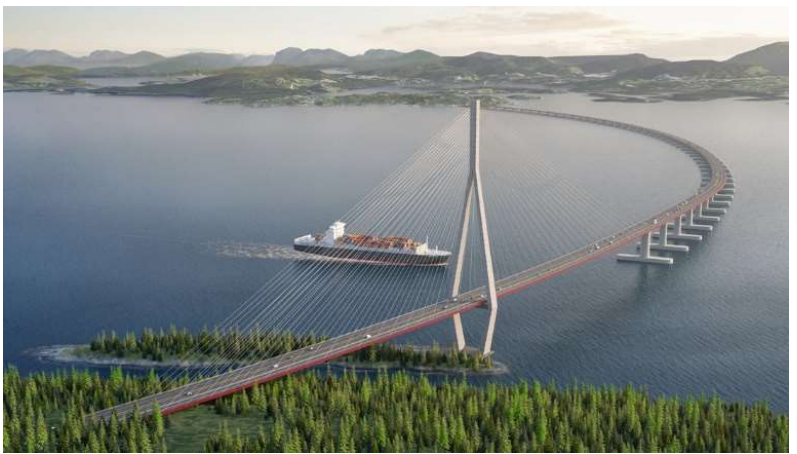
This presentation deals with a risk assessment of an “early” design of a nearly 5 km long floating bridge (Fig.1), in order to prepare the basis for the detailed design. The major part of the bridge is supported by pontoons while a cable stayed high bridge, to provide for ship passage in a navigation channel, is supported by a tower on the seabed. The focus is on the ship impact hazard, which is the major “accidental - type” of load. Such impacts might hit the girder and, most importantly, pontoons. Pontoon impacts might cause structural damage and flooding with loss of buoyancy. Pontoon damage will be repaired by use of cofferdams or by using a drydock (Fig.2). A temporary repair or mitigation of buoyancy loss, might be considered if the impact occurs during the winter, followed by a permanent repair conducted during summer.
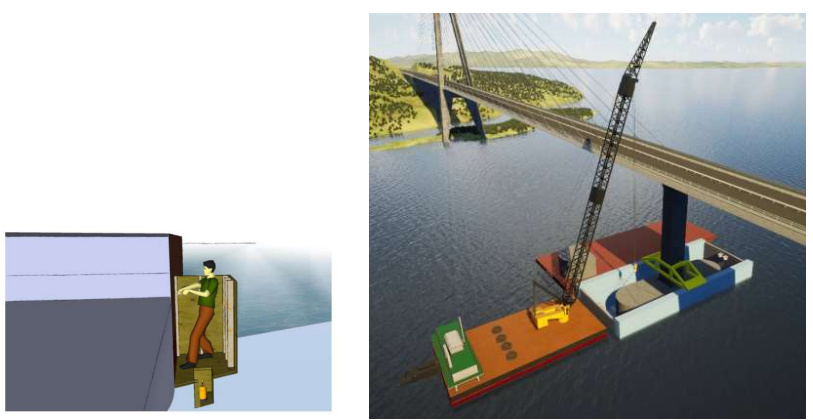
While both the fatality and traffic disruption risks are considered, the focus in this presentation, is on the risk of traffic disruption, which also governs the economic risk. Use of the bridge in damaged or repair conditions, require fulfillment of SLS and ULS and FLS criteria in these conditions. However, use of the bridge under road traffic restrictions (use of some lanes only, speed limit) is considered an option in this connection.
Traditional risk analyses have, in principle, a wide scope and tend to be based on simplified risk estimates. In this study it is demonstrated that a comprehensive assessment is needed to come to the decisive conclusions about risk mitigation measures to be implemented. The risk assessment involved the following steps: estimation of the frequency of impact scenarios, and conditional probability of immediate damage and road traffic disruption on the bridge in damaged and repair conditions. The analysis of impact damage and consequences for the floating bridge differ from that of a conventional bridge. These efforts involved significant global dynamic analysis, with account of structural nonlinear features, of multiple impact events, and global dynamic analyses of the structure in damaged and repair conditions, under permanent-, environmental and traffic loads. It turned out that the repair method could have a significant influence on the road traffic disruption.
Target risk criteria in terms of annual expected traffic disruption time, and frequency vs. traffic disruption time (FN-curves) are commented upon. Various measures to mitigate the road traffic disruption risk are discussed, with emphasis on the introduction of design criteria beyond the accidental collapse limit state requirements which address survival of the structure in a damaged conditions caused by hazards with an annual probability of \(10^{-4}\).
Source and citation#
Suggested citation: Moan, T. “Risk analysis and acceptance for floating bridges, with emphasis on ship impact hazards.” Extended abstract, Workshop on Risk Acceptance Criteria in Civil Engineering Decision Making, Trondheim, Norway, 19 to 20 June 2023.